Posts mit dem Label Les contes d'Hoffmann werden angezeigt. Alle Posts anzeigen

Montag, 21. Dezember 2009

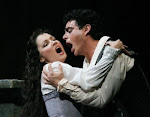
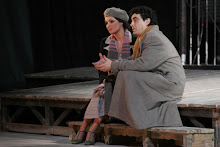
Les contes d'Hoffmann review - 19th December 2009

"My wife Paula and I attended the Les Contes d'Hoffmann performance at the MET on
19-December which was also simulcast around the world as a live broadcast. As
snow was encroaching on New York City, the crowds came out to see the Tales of
Hoffmann. I totally agree with Irina, that there is truly nothing like a live
performance, although this spectacle deserves a second review with the encore HD
performance in January. Although there were some vacant seats due the inclement
weather it was clear that Netrebko has her devoted following. The gift shop was
playing a DVD of her Berlin Concert with Villazon and Domingo and copies were
literally flying off the shelves. One woman flew in from Dallas just for this
performance. The MET intentionally sanitized this production leaving out the
partial nudity (G strings and pasties) reviewed by Anthony Tommasini of the New
York Times.

There was a rousing ovation for James Levine who recently returned from back
surgery for a ruptured disc. He has the uncanny ability to allow the orchestra
to support, but not overpower the singers. Bartlet Sher the director pretty
much took a static opera with no dimension of time or change of venue. and made
a spectacle of the opera. While there were some incongruities, it pretty much
came off rather well and was very well received. Olympia, the mechanical doll
played by Kathleen Kim was adorable, cute and sang with coloratura ease. She
danced and walked like a mechanized doll as the voice lifted just like a young
adolescent nymph. This was not the role for Netrebko. Although other
productions have had wind up keys built into the costume, this rendition was
just adorable. Ekaterina Gubanova as Giuletta was stiff and uninspiring. The
part of Nicklausse sung by Kate Lindsay was just average, as her voice and
expression appear not ready for prime time. Alan Held had a commanding presence
as Dr. Miracle and sang with convincing authority. The clear winners of the
afternoon were Joseph Calleja as Hoffmann and Anna Netrebko as Antonia. Calleja
displayed confidence, presence and endurance. His voice has an unusual
tenderness and affection that is reminiscent of Jussi Bjorling. Calleja had
strength, the ability to project and literally sang the entire opera without
much rest. His tenderness in recounting his lost loves came across with passion
and conviction. This is an enormous role early in his career and it was clear
that he was up to the task. Although Anna Netrebko's role as Antonia in the 2nd
act was limited, she ruled the stage with passion, illumination and exquisite
acting ability. One only has to think of her Salzburg Traviata for an analogy.
Her deep Slavic tone and elegant poise was well suited to this role. She truly
commanded the stage and all around her. Her duets with Hoffman were poignant,
elegant and dramatic. She had the ability the sing along with his commanding
presence. She was dressed in a beautiful nightgown that highlighted her style,
grace and sumptuous figure. It is evident that she has lost much weight after
her pregnancy, but her voice and timbre have become richer, more colored and
exquisite. There were time when you could pick out her voice on top of the
chorus. She has not lost her high register at all and there were some hints of
exquisite trills in her singing. In short, this role was made for her, a
sumptuous, melancholy lover with a great sense of pathos and drama.
At intermission, I met a gentlemen who was at her MET debut in War and Peace.
He said that he heard a lone voice above the chorus that transcended all. He
said that he knew then that she was very special as only time would demonstrate.
He loved her role here, but was not as enthusiastic about her coloratura
capabilities in Lucia last year.

The production did have some weaknesses that seemed to detract from the overall
message. In the opening of the third act which simulated an orgy or bordello,
the well choreographed dancers with exquisitely flexible bodies were on top of
men reminiscent of strippers at a bar. Their modern day costumes seemed out of
place from the elegant victorian gowns and long coat worn by Hoffmann. My wife
found some of this mildly offensive and inappropriate. If this was the
sanitized version, I am sure that other performances had similar responses.
Parts of the opera appeared to make fun of the Jews and were mildly anti-Semitic
in nature. While not offensive, it is clear that Bartlet Sher chose to
highlight these issues in his interpretation. I found it to be mildly amusing
and perhaps this reflects some of Offenbach's beliefs.

Some general thoughts are in order. Having attended opera and concerts
throughout Europe, I am astounded by the lack of decorum of many participants in
the audience. On a Saturday afternoon where tickets are rather expensive, I am
shocked by people dressed in dungarees and sweatshirts. My opinion is that the
audience should be respectful to others in the audience as well as the
performers. People sitting next to me in the opera talked throughout the opera
and you could hear the incessant vibration of cell phone and occasional audible
ones that were extremely bothersome. As Hoffmann was singing his heart out in
the 3rd act, a cell phone went off at the most inopportune time. I realize that
times are much more casual than in the past, but a modicum of decorum,
appropriate dress and behavior is a rather low bar for such an exquisite art
form.

In closing our trip to NYC was well worth the effort. Netrebko was enchanting,
ravishing and skilled in her abilities. Our trip home was delayed by snow and
ice, but fortunately we had a young female bus driver that was safety conscious,
courteous and skilled in her driving abilities. She had to stop 4-5 times to
clear ice from the wipers. Fortunately she beat the storm as she traveled North
to Boston.

Looking forward to Boheme later this spring as well as Carmen with Garanca.


Howard"

Many thanks to you, Howard, for your great and detailled review ! Feels like you have been there yourself !

(I'm sorry I don't know why it appears like this...and I don't know how to change it...)

Sonntag, 6. Dezember 2009

Hoffmann photos

Hoffmann reviews

The Old Stories, Updated With G-Strings

There is much to cheer about in the Metropolitan Opera’s phantasmagorical new production of Offenbach’s “Contes d’Hoffmann” (“Tales of Hoffmann”), which opened on Thursday night.

The mezzo-soprano Ekaterna Gubanova as the Venetian courtesan Giulietta
As conceived, this production was to have featured the tenor Rolando Villazón as the poet, wild-eyed dreamer and delusional lover Hoffmann. When Mr. Villazón, in the midst of a vocal crisis, pulled out last spring, the young Maltese tenor Joseph Calleja, who had never sung this daunting role, accepted the assignment. On Thursday he gave his all, singing with ardor, stamina and poignant vocal colorings and winning a rousing ovation. There were technically shaky elements to his performance, and his focused, quick vibrato revealed every slight inaccuracy of pitch. Still, the insecurity actually befitted Mr. Calleja’s take on the character, laid bare emotionally.

The soprano Anna Netrebko may have disappointed her fans by deciding not to sing all four of Hoffmann’s love interests, as originally planned. But she was vocally lustrous, charismatic and wrenching as Antonia, the sickly and frustrated singer who has been warned that singing will lead to her death. She also made a captivating and tart Stella, the prima donna Hoffmann is smitten with.

And James Levine, in his first performance at the Met since losing some two months of work because of back surgery, received a prolonged ovation from a welcoming audience when he appeared in the pit. He then drew a supple and bewitching performance from the great Met orchestra.

Still, the post-premiere discussion will probably focus on the acclaimed director Bartlett Sher’s fantastical production. Mr. Sher proved himself to opera buffs with his sleek and charming 2006 production of Rossini’s “Barber of Seville,” in revival at the Met this season. “Hoffmann” is a far more challenging and elusive assignment.

For me, the staging is marred by moments of excess and busyness. And Mr. Sher may have done too much analysis of the work’s psychological subtexts. We get a little bit of everything in the stage imagery: pasty-faced characters out of a Kafka tale; waiters in bowler hats who could have stepped out of a Magritte painting; decadent, orgiastic Felliniesque scenes at the palace in Venice where the courtesan Giulietta presides; and more.

Yet Mr. Sher, working with the set designer Michael Yeargan and the costume designer Catherine Zuber, does get to the emotional core of the opera. This Hoffmann, dressed in a plain suit suggesting 1920s Eastern Europe, spends most of his days seated at a humdrum writing table, with a battered typewriter and a small desk lamp. That desk is where he belongs. At least that is the conviction of the Muse of Poetry, who in the guise of Nicklausse, Hoffmann’s devoted friend, follows him everywhere. The mezzo-soprano Kate Lindsey, singing with warmth and subtlety and looking alluringly androgynous, makes a trustworthy muse.

Luther’s tavern, next to the opera house where Stella is starring in “Don Giovanni,” is the only public place where Hoffmann is in his element. During the Prologue, egged on by the students who frequent the tavern and hang on his stories, Hoffmann sings an impish ballad about the dwarf Kleinzach, which Mr. Calleja dispatched with snappy energy and ringing top notes.

After the Prologue, during the next three acts, all flashbacks, Hoffmann tells the students the stories of his three disastrous romantic obsessions. Mr. Sher makes clear that these really are tall tales. Imagery and characters bleed from one story into the others. In the workshop of the eccentric inventor Spalanzani (the hearty tenor Mark Schowalter), where the guests assemble to see the demonstration of Olympia, his mechanical doll, voluptuous women dressed in nothing but G-strings and pasties wander through the audience. Two acts later they are seen again as occupants of the palace of the Venetian courtesan Giulietta.

It makes sense that Hoffmann’s stories would become jumbled in his mind, and in his telling. Still, the act featuring Olympia is quite a jumble. This mechanical doll is one of a whole product line of dolls, who strut about in garish ballet dresses. Some of the guests seem to have drifted in from “The Cabinet of Dr. Caligari.” The staging has style and wit, but it seems too busy, too much.

Ideally, Offenbach wanted one soprano to sing all four of Hoffmann’s love interests. Ms. Netrebko may have been wise to pass on Olympia. The role’s high-flying runs and roulades require a true, agile coloratura soprano, and this production has one in the petite Kathleen Kim, who excelled in Olympia’s showpiece aria, singing with pinpoint pitch, bright tone and impressive accuracy.

The mezzo-soprano Ekaterina Gubanova was a suitably dark-hued and sensual Giulietta, dressed incongruously in an 18th-century gown. The baritone Alan Held was husky-voiced, imposing and often chilling, portraying the four devilish villains who torment Hoffmann.

The tenor Alan Oke was delightful in four minor character roles, especially as Franz, the hapless servant in Antonia’s house who secretly longs to be a singer. (This was a far cry from his Met debut performance as Gandhi in Philip Glass’s “Satyagraha.”)

Whatever the vocal issues with Mr. Calleja’s Hoffmann, he withstood the pressure of singing this formidable role for the first time in a major new production at the Met, and saved the day. He needs to do more work with his voice, but he is a gifted and promising tenor.

There is an enormous controversy about the score of this opera. Offenbach died four months before the work’s 1881 premiere in Paris. None of the versions of the work that have appeared over the years, some of them corrupted, can be said to be authentic. I will have more to say on this question later. Mr. Levine, as is his prerogative, conducted a version that he and advisers at the Met fashioned from existing sources.

Whatever scholars of “Hoffmann” believe about the validity of the choices made here, the opera as presented had integrity and dramatic flow. If the production is not a revelation, the Met’s new “Hoffmann” is a musically gratifying and vividly theatrical staging of a haunting and, in its way, profound work.

And click here and here

Samstag, 14. November 2009

Met opens final dress rehearsal of “Hoffmann” to the public

Met opens final dress rehearsal of “Hoffmann” to the public

The Metropolitan Opera’s fourth season of free final dress rehearsals continues on Monday, November 30 with Bartlett Sher’s new production of Offenbach’s Les Contes d’Hoffmann, staring Anna, Joseph Calleja, and Alan Held, and conducted by Met Music Director James Levine. The dress rehearsal begins at 11:00 am; and the doors will open at 10:30 am. Approximately 3,000 free tickets will be available (2 tickets per person) through an online ticket drawing; entries will only be available at the Met’s website at http://www.metoperafamily.org/metopera/ The entry dates are from Friday, November 13 through the evening of Wednesday, November 18. Winners will be chosen on Thursday, November 19 and names will be posted on the Met’s website that afternoon.

Mittwoch, 1. April 2009

Rolando as Hoffmann on BBC Radio 3

Click here for the whole (bzw. ^^ detailed) information =)

Thanks to Rhodri for the info !

Dienstag, 10. Februar 2009

Met season 2009/2010

Today published the Met the new season schedule for the season 2009/2010. Anna and Rolando will stand together on stage in Les contes d'Hoffmann:

Les Contes d’Hoffmann
A powerhouse team joins forces for Offenbach’s psychological fantasy. James Levine conducts, and Tony Award® winner Bart Sher (South Pacific) returns after the triumph of his Met Barber of Seville to direct. Inspired by Kafka, Sher describes his production as “a magical journey in which the character works out different manifestations of his psyche.” Rolando Villazón plays Hoffmann, a tour de force role for the tenor. Also starring soprano Anna Netrebko as the tragic Antonia, Elina Garanca as the ambiguous Nicklausse, and René Pape as the demonic four villains.


Click here for watching the dates.

The new production gala will be on 03rd December 2009. Click here for details.

The 19th Decembers' performance will be broadcast by Met HD.


Furthermore will Anna sing Mimì in La Bohème:

La Bohème
Anna Netrebko stars in the most popular opera in the repertory. Piotr Beczala, who signaled his arrival as a top lyric tenor in last season’s Lucia di Lammermoor, sings his first Met Rodolfo in Franco Zeffirelli’s legendary production. Gerald Finley is Marcello, opposite Nicole Cabell and Ruth Ann Swenson alternating as Musetta.


Click here for watching the dates.

Wow that are great news ! =) I'm really looking forward to Les contes d'Hoffmann because Antonia is one of the roles I want to sing her the most ! Together with Rolando and Elina, could it be better ?! ; ) And it's part of the Met HD serie that's absolutely fantastic ! =)

Montag, 8. Dezember 2008

Rolando's Hoffmann yesterday at the ROH

I woke at 6.00am on Sunday morning slightly nervous, and very pessimistic about Hoffmann. I caught the 9.48am Cardiff to London train still very pessimistic. I ate lunch at my favourite Italian in London, Carluccio's in Covent Garden, yes…still pessimistic. This pessimism continued as I walked, or rather long jumped, over the street engineering works towards the opera house.

And...he sang! There was a sense of nervousness among the audience beforehand as the lights dimmed. I was waiting for someone to come on stage to announce that he wasn't going to sing, but as Antonio Pappano set the orchestra into motion I knew he would sing...

At first he seemed to be saving his voice, finding out how much he could use it, but as the afternoon wore on he settled and his voice grew in volume - although it wasn't as powerful as I've heard on recordings (or even when he sang at the In Conversation I attended in November), and he was overpowered by Giuletta (Christine Rice) in their duet. But in comparison to where he was several months ago his voice has recovered a great deal, and in other reviews of Hoffmann it was reported that the strength was there, so he may well have been protecting his voice following his recent cold that caused Thursday's cancellation. But the "sound" of his voice, the golden warmth, was there - and in his final arias he did sing with greater conviction (especially his final lines) - and a shiver did run down my back!

His acting was exceptional, allowing the passion of his singing to convey Hoffmann's emotions, making him the standout performer on stage in terms of acting and singing. He was comical, he was sad, he was passionate, he was tragic. He was lost. He was Hoffmann!

Among the other singers Kristine Jepson's effortless soprano made a very enjoyable Nicklausse and Muse, Christine Rice's Giuletta was highly believable and Ekaterina Lekhina's Olympia was mechanically perfect (which should be read as a compliment). Gidon Sacks, although possessing certainly enough vocal heft in the bass passages, did have a slight mishap on the high denouement of "Scintille diamant", but overall he was a convincing bad guy – perhaps he will be better suited to the role a few years from now when he will have built up the required stamina.

Overall, it was a Sunday afternoon worth getting up at 6.00am for, and for this I have the performers, the orchestra (led by Pappano), the ushers of ROH and most importantly Offenbach (and his collaborators) for the musical feast I enjoyed – it certainly kept me warm on my return journey home!

Thanks a lot to Rhodri for his very interessting and very detailed report !

Donnerstag, 4. Dezember 2008

Rolando talking about Les contes d'Hoffmann

Here you can watch a video (from the ROH site), where Rolando talks about Hoffmann. Short but very nice ;)

Samstag, 22. November 2008

Rolando's latest interview

Here you can read Rolando's latest interview with the "Times online" magazine. The interview was made because Rolando will stay on stage for 7 performances of "Les contes d'Hoffmann" (The Tales of Hoffmann) from 25th november till 13th december at the ROH.

I think it's a very good interview, hope you enjoy it, too =)

Four years ago a hurricane blew on to the stage of the Royal Opera House. The opera was Offenbach’s The Tales of Hoffmann, the staging a creaky production still best known for its association with Plácido Domingo, who had sung the title role when it was new in 1980. But now it finally had a star worthy to succeed him, a dishevelled figure who stumbled down the stairs on his first stage entry in a frighteningly convincing display of inebriation, and proceeded to thrill us all evening with his reckless charisma.

His name was Rolando Villazón, a Mexican tenor, like Domingo, and possessed, like Domingo, of a darkly baritonal voice wedded to a magnetic stage presence. Suddenly we had a fitting vehicle for the demonic, pathetic, obsessive role of Hoffmann, the poet who can’t separate his Gothic fantasies from his own hopeless life.

Villazón’s performance, his Covent Garden debut, catapulted him into the stratosphere. “It’s one of the most beautiful memories of my career,” he says. I was there, too, and perhaps the most endearing sight was Villazón jumping up and down with excitement as he received his ovation.

Villazón still wears his heart on his sleeve. I think my Dictaphone will never be the same after an hour in close proximity to his exclamations and huge repertoire of quirky sound effects, which fulfil a vital function in propping up his vibrant but sometimes restricted English. But when I meet him at the Royal Opera House during rehearsals for his second Covent Garden run as Hoffmann, opening on Tuesday, he is troubled. “The story of Hoffmann should tell something that goes beyond just a good night at the opera,” he says, eyebrows twitching. “It’s beyond aesthetic impression, beyond entertainment.”

In part this is Villazón’s deeply ingrained commitment to the drama. I ask him about singing the title role in Don Carlo, a punishing role that he took on in May at Covent Garden to very mixed reviews, and if he’s defensive it’s only because he felt he missed out on the dramatic rather than the vocal demands. “I think there was one performance when I had an allergy, which was frustrating for me, not because I was not able to sing the notes, but because I was not able to portray the character.”

But Villazón’s passionate belief in opera “beyond aesthetic impression” goes farther than just histrionics. Last year Villazón almost walked away from his entire career, taking five months off from opera entirely. It was an audacious move, made all the more mysterious because his record label, Deutsche Grammophon, and management kept so quiet about it. It also opened up a huge debate about the 24/7 pressures facing the 21st-cen-tury opera singer.

So, what happened? “I was exhausted! And it was not necessarily vocal cords. My iron levels were low, I was in pain every week. I was trying to be close to my family, but at the same time giving interviews, promoting CDs, and recording, rehearsing and learning roles – it’s too much. It’s very hard to control your career. It’s a psychological goal you have to reach, to be happy not doing all the new productions, and all the wonderful concerts, that it’s actually fine to say no to most of them.”

He insists the break wasn’t to do with any great defects in his voice: more likely, in fact, that it was the inevitable result of the intensity with which he takes on every project, be it a CD (his most recent release, the passionate but patchy Cielo e Mar, is a good example) or a staged opera. “I always knew that with my way of being there was going to be a moment of pain. I just never thought it was going to happen so soon.”

And yet what began as a simple rest cure has taken on deeper implications. Villazón, who when we meet is clutching a a dog-eared copy of Tolstoy’s What is Art?, wants opera, and his place in it, to change fundamentally. “When I stopped I could have stopped for five weeks. I stopped for half a year. I needed to think: why do I do this? Is it for vanity? Is it just for entertainment? No. We need to look for that message that lies in every real artwork.”

It’s a war Villazón is now actively waging, albeit a tad erratically. When he launched Cielo et Mar in the UK, at a lunchtime reception at the Royal Opera House, he insisted on treating his corporate hosts to a speech in which he railed against consumerism. He sings the same tune now, castigating not just himself, but the record industry, the public and the media for trivialising the art-form. “I think the art of singing has become like a sports event with all the celebrity around it. If the hype around opera singers is not sustained by real work and by real talent, it goes away. Fame used to be associated with respect.”

At no point does Villazón warm more to this theme, a colourful Jeremiad about the health of the Western world, than when I touch upon his much-discussed partnership with Anna Netrebko. The two prize assets of Deutsche Grammophon were aggressively marketed by the label as a duo, particularly in Germany and Austria, and until recently they sang together frequently on stage.

They also appear this Christmas in a glossy film adaptation of Puccini’s La Bohème. “A story was told through pictures about me and Anna that was not true or correct,” Villazón recently commented, an observation he now struggles to retract. “It was abused . . .” he concurs, before pausing, perhaps to consider what his label bosses might make of his words. “I think the CD label was just taking what journalism had done already – the ‘dream couple’, the ‘ traumpaar’ – and the whole thing that happened was born in the press. It sustained a couple of projects and then we go to perform with other artists. The danger is to make it all about that. But that’s the problem of our time. Fame obscures.”

I wonder just how much Villazón can really achieve of his twin goals: personal-professional balance, a recording career without the celebrity fluff. He talks of reducing commitments before revealing that he has just jetted off to Berlin to sing for Daniel Barenboim, “one of the most fulfilling nights of my life”. And he admits that image and personality not only bring new converts to opera, but are also essential on stage. “It’s a struggle. You need your individuality, you need a certain arrogance. You cannot just be an empty glass.”

Most of all I wonder whether Villazón really can overcome that “way of being”, that nerve-shredding focus on finding the drama in everything he takes part in. Could he, if only for the sake of his mental well-being, simply accept that opera might just be a job? “Yes, it’s a job, but it’s not a job. It doesn’t finish when you go home. You go home thinking of your character. Your kids go to school and then in the walk from school to home I keep asking myself – what is the purpose of art? It’s a way of living, being a performer.”

Thank Mrs Villazón, a psychologist, for bearing all this angst. “She has been the rock I can hold on to. Without her I would not be here.” So thank her, too, then, for this second crack at Hoffmann.“Four years ago it was still too much about my first Hoffmann, my first Covent Garden . . . it was still too much about Rolando Villazón. Now it’s going to be about Offenbach.” Just remember that after the ovations he’ll keep wondering whether he managed it.